
The Biological Completion Model™ (BCM) is a biological framework for understanding and working with the way the nervous system organises when safety is threatened, and how it reorganises when interrupted protective responses can finally be completed.
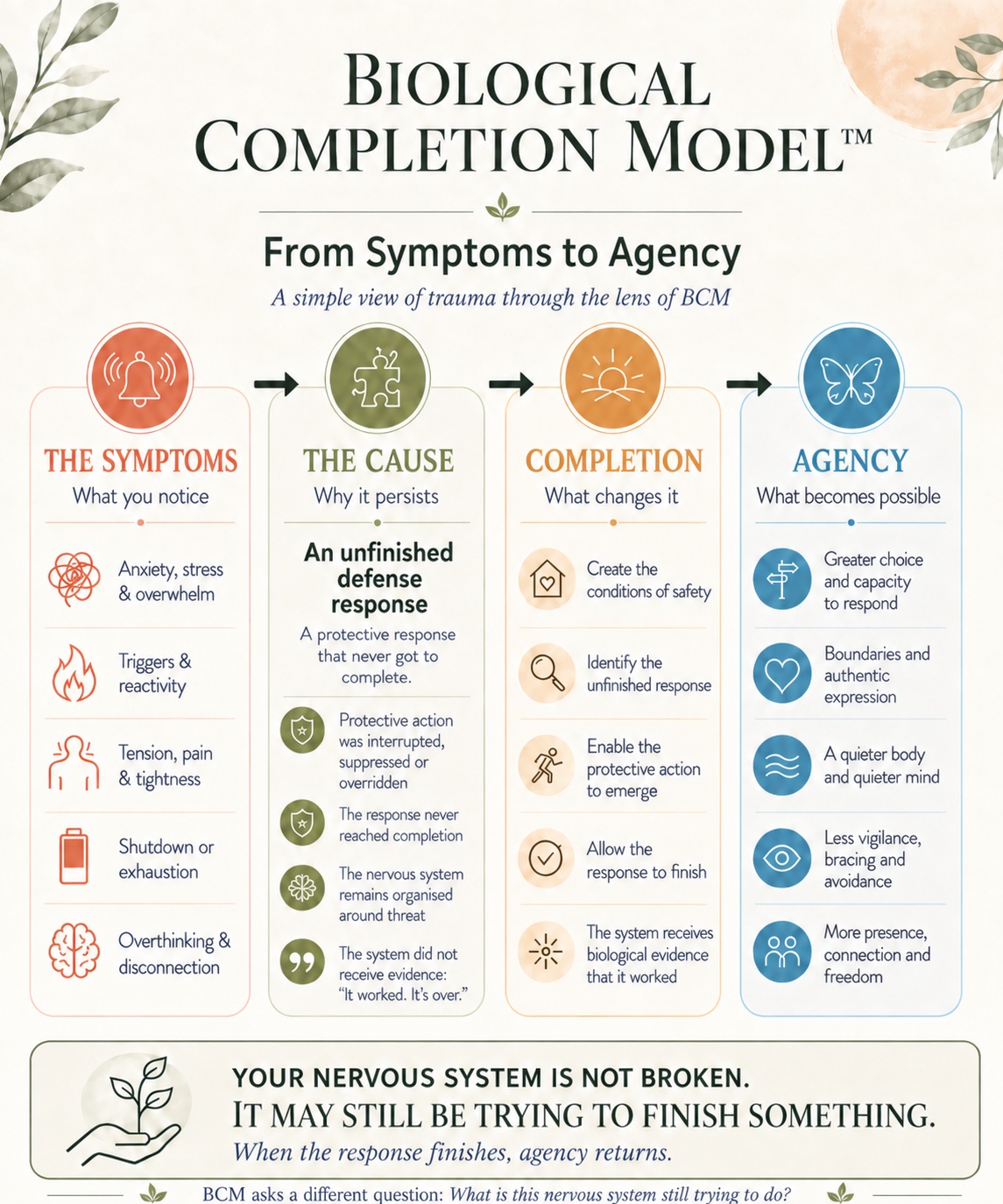
BCM is built on the biological principle that the nervous system is designed to detect and respond to threat. When a protective response is interrupted, the nervous system continues to organise around the threat until that response can be completed.
Across diverse experiences of stress and trauma, BCM returns to the same organising principles. Rather than treating each presentation as fundamentally different, BCM asks how the nervous system has adapted—and what conditions allow it to reorganise.
Rather than beginning with symptoms, diagnosis or pathology, BCM begins with biology.
It asks a simple question:
What is this person’s nervous system still trying to do?
Is it still preparing to protect?
Still anticipating danger?
Still responding to a threat that has never been fully resolved?
When we begin with the nervous system rather than the symptoms, many experiences that once seemed confusing begin to make sense.
The answers change not only how we understand trauma, but how we understand recovery itself.
Rather than viewing anxiety, pain, shutdown, hypervigilance and other symptoms as problems to eliminate, BCM understands them as meaningful expressions of how the nervous system has organised around threat.
A biological framework
BCM is not a standalone therapy or a single technique. It is a biological framework that maps the process by which defensive responses become unfinished and continue to organise the nervous system. That framework helps practitioners understand what they are observing and guides how they work toward completion and restored agency.
Because it is a framework, BCM can be applied across many settings, including individual sessions, practitioner training, leadership development, education and group programs.
Whether we are working with trauma, leadership, education or relationships, the organising principles remain the same.
Seeing the pattern
The nervous system is continually adapting to its environment. When safety is threatened, it organises around the threat. When protection is no longer required, it reorganises.
BCM helps practitioners recognise these biological patterns beneath behaviour, emotion and physiology, creating opportunities for meaningful change rather than simply managing symptoms.
From protection to possibility
When the nervous system no longer needs to organise around persistent threat, resources become available for living.
People often notice that they:
- breathe more freely
- feel stronger and more grounded
- think more clearly
- respond rather than react
- reconnect with themselves and others
- experience greater freedom and choice
BCM describes this as the restoration of agency—the capacity to respond to life with greater flexibility, confidence and autonomy.
Built on biological principles
BCM integrates observations from nervous system function, trauma, movement, prediction, adaptation and the completion of protective responses into a single organising framework.
The model continues to evolve through clinical observation, practitioner training and ongoing refinement.
It provides the foundation for everything we do at Free Rein Australia.
Whether you are seeking support for yourself, exploring practitioner training, or interested in understanding stress, trauma, and the nervous system from a biological perspective, BCM offers a coherent framework which is built on a simple premise: when we understand what the nervous system is trying to do, meaningful change becomes possible.
To learn more about the theory behind BCM—including the concept of the unfinished response—explore The Unfinished Response.
Privacy Policy I Terms of Service I Refund and Cancellation Policy