Next Training Dates for Full BCM Practitioner Training
October 16 – 18, 2026
November 20 – 22, 2026
January 15 – 17, 2027
February 26 – 28, 2027
We currently cannot access Facebook or Messenger enquiries.
To contact us please send email to info@freereinaustralia.com or
phone/text to 0411 593 369
BCM is a different way of understanding trauma — and a different way of working with it.
The Biological Completion Model™ understands trauma as an unfinished defensive response that continues to organise the nervous system long after the original threat has passed.
From this perspective, symptoms, behaviours and protective strategies are not separate problems to be treated one by one. They are expressions of the way the nervous system has organised in response to threat.
Once that organisation becomes visible, the work becomes clearer.
Rather than asking how to reduce a symptom or manage a presentation, BCM asks: “What is the nervous system trying to do?”
Nothing the nervous system does is random.
The nervous system responds to threat in organised and predictable ways. Defensive responses follow a hierarchy, one response can inhibit another, and what appears on the surface as anxiety, shutdown, avoidance, anger, collapse or dysregulation often makes sense when viewed within the larger defensive process.
BCM gives practitioners a way to recognise that process.
Training develops the ability to identify unfinished defensive responses, understand what is preventing them from progressing, and support the client to develop the capacity needed for the nervous system to move forward.
This includes learning to recognise and work with survival-based inhibitors — protective responses that developed when the nervous system had to prioritise survival, but which can later prevent the person from accessing other ways of responding.
The aim is not simply to settle activation or produce relief. It is to understand what remains unfinished, what is getting in the way, and what needs to become possible for the response to reach completion.
Completion is the mechanism.
Resolution is the outcome.
Agency is the destination.
One Process You Can Follow
Trauma can present in many different forms. Different people arrive with different histories, symptoms, behaviours, patterns of relating, diagnoses and ways of coping, yet BCM does not require a separate theory or technique for each presentation.
What remains consistent is the biological organisation beneath them.
That gives the practitioner something stable to work from.
Instead of deciding what to do based primarily on the presentation, you learn to look beneath it and recognise how the nervous system has organised around threat, which responses are unfinished, what is inhibiting them, and what needs to change for the process to move forward.
Sometimes that means helping the client build greater capacity before completion is possible. Sometimes it means working with inhibition. Sometimes the nervous system is ready for a more direct protective or survival response.
Over time, this creates a more coherent way of working. You are no longer holding multiple explanations in mind or searching through a toolkit for the right intervention. You are learning to recognise where the nervous system is within a biological process and what it requires next
BCM trains you to see what is possible.
Regulation, insight, expression and autonomic discharge can all be valuable, but BCM does not assume that any of them mean the defensive response has been completed.
Training develops the ability to distinguish temporary relief from a genuine change in nervous-system organisation.
Posture, movement, muscle tone, breathing, gesture, expression and orientation are observed in context. Rather than treating them as isolated somatic cues, you learn to read them as part of an organised response.
You also learn to recognise the threshold between inhibition and greater agency: the point at which the nervous system becomes able to do something that was previously unavailable.
This changes the role of the practitioner. The work is neither passive nor prescriptive. Sometimes you follow what is emerging. Sometimes you wait. Sometimes you invite movement, provide resistance, challenge an inhibition or support a protective action. At other times, the most important decision is recognising that the nervous system is not yet ready to proceed.
The framework guides the work, but the nervous system determines the process.
The client brings the nervous system. You bring the framework.
The BCM Practitioner Training
The Biological Completion Model™ Practitioner Training consists of four three-day, in-person modules.
The training progresses through two stages of practice.
Modules 1 & 2 — Phase 1: Understanding and Preparing the Nervous System
The first two modules establish the foundation of BCM and develop the practitioner’s ability to recognise how the nervous system organises in response to threat.
Participants learn to:
- understand trauma through the lens of the unfinished biological response
- recognise patterns of nervous-system organisation beneath symptoms, behaviours and stories
- understand the hierarchy of defensive responses and how different responses relate to one another
- identify and work with survival-based inhibitors that prevent protective responses from completing
- assess what the nervous system is currently organised around and what it is ready for
- work with safety, capacity, presence and activation without simply trying to regulate symptoms
- recognise the conditions required before biological completion can occur
- begin identifying the specific response the nervous system is attempting to finish
The theoretical foundation introduced across these modules include unfinished response, defensive organisation, inhibition, prediction, resolution, integration, agency and the conditions required for nervous-system reorganisation.
Modules 3 & 4 — Phase 2: Biological Completion
The second half of the training moves into the completion process itself.
Participants learn to:
- recognise when the nervous system has reached the threshold for completion
- identify the specific protective or defensive response that was interrupted
- look for preventative responses that remain unfinished
- work with remaining inhibition that may prevent that response from being expressed
- support the nervous system to complete the response safely and accurately
- distinguish completion from activation, emotional expression, discharge or symptom relief
- support resolution and integration
- recognise the physiological and behavioural markers that indicate genuine reorganisation
- work with more complex presentations where multiple defensive responses may be involved
- support the restoration of agency following completion
Throughout all four modules, theory is integrated with observation, demonstration and supervised experiential practice.
Participants are not simply taught techniques. They learn a coherent framework for understanding what is sustaining the client’s current nervous-system organisation, what is preventing resolution, and what needs to happen next.
The central question throughout the training is: “What is the nervous system trying to do?”
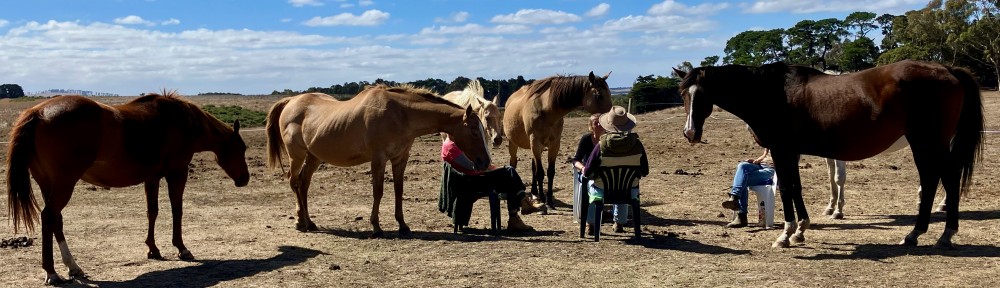
Horses Support Optimum Learning Conditions
Who is the Training For?
Apprenticeship Program
TO REGISTER